| Journal title | Journal of Coastal Sociology |
| Initials | JoCS |
| Frequency | Biannual (March and September) |
| DOI | https://doi.org/10.37905 |
| Online ISSN | xxxx-xxxx |
| Print ISSN | - |
| Editor-in-chief | Sahrain Bumulo [ScopusID: 58125826500] |
| Managing Editor | Dewinta Rizky R. Hatu [ScopusID: 58990887300] |
| Publisher | Department of Sociology, Faculty of Social Sciences, State University of Gorontalo, in collaboration with the Association of Indonesian Sociology Study Programs (APSSI) |
| Country | Indonesia |
| Language | English |
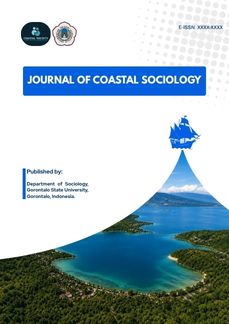
Journal of Coastal Sociology (JoCS) is an international peer-reviewed scholarly journal dedicated to advancing sociological and interdisciplinary research on coastal societies, maritime social change, and the social dimensions of coastal and marine transformation. JoCS published by the Department of Sociology at Gorontalo State University, Gorontalo, Indonesia, in collaboration with the Association of Indonesian Sociology Study Programs (APSSI). The journal provides a critical academic forum for theoretically informed and empirically grounded studies that examine how coastal communities experience, negotiate, resist, and transform social, economic, cultural, political, and environmental change across diverse coastal, island, archipelagic, and marine settings.
The journal is founded on the understanding that coastal areas are not merely physical zones, ecological systems, or management units, but socially produced spaces shaped by livelihoods, identities, inequalities, institutions, cultural meanings, historical trajectories, and relations of power. It seeks to strengthen coastal sociology as a distinctive field of inquiry by placing coastal people, communities, and social relations at the center of scholarly debates on climate change, blue economy, coastal governance, sustainability, migration, marine conservation, coastal urbanization, fisheries transformation, and social justice.
JoCS welcomes contributions from sociology and related fields, including anthropology, human geography, development studies, environmental studies, maritime studies, political ecology, gender studies, cultural studies, public policy, and sustainability studies. While the journal encourages interdisciplinary engagement, submissions must demonstrate a clear social, sociological, or community-centered contribution to the understanding of coastal and marine life.
The journal particularly encourages comparative, conceptual, methodological, and theoretically engaged studies, as well as empirically rich research from underrepresented coastal, island, archipelagic, Indigenous, and Global South contexts. Local or regional case studies are welcome when they offer broader analytical, theoretical, methodological, comparative, or international relevance.